
Rom 15:16 ‘’That I should be the minister of Jesus Christ to the Gentiles, ministering the gospel of God, that the offering up of the Gentiles might be acceptable, being sanctified by the Holy Ghost.”
Rom 12:1 “I beseech you therefore, brethren, by the mercies of God, that ye present your bodies a living sacrifice, holy, acceptable unto God, which is your reasonable service.”
It would be a little discouraging, to say the least, to put forth the effort to offer a sacrifice to God and then have that offering not be accepted by Him. However, a rejected offering would indicate an errant, compromised, or otherwise corrupted effort, and this is fixable. Many folks have said and apparently believe that any effort, any sacrifice, any offering in any condition to God will receive a commensurate reward from Him. This is not what the scriptures teach. Though his yoke is easy, and his burden is light (Matt. 11:30) and though his commandments are not grievous (IJn. 5:3), the scriptures do teach however that God has some requirements concerning our “offering up” unto him. This was Paul’s concern when he said “…that the offering up of the Gentiles might be acceptable, being sanctified by the Holy Ghost.” In this statement Paul implies the prospect of unacceptability regarding “the offering up of the Gentiles”. He also indicates that the acceptability of the offering is contingent upon it being “sanctified” (made holy) by God, with this sanctification being rendered by the “Holy Ghost”.
The first and overarching sacrificial event, an offering unto the Lord, in the Bible story would be that ironically described in the last book of the Bible. Rev. 13:8 “… the Lamb slain from the foundation of the world.”, even Jesus, who Heb. 9:14 “…offered himself without spot to God,..” , Heb. 7:27 “Who needeth not daily, …to offer up sacrifice, …for this he did once, when he offered up himself.”. Heb. 9:28 “So Christ was once offered to bear the sins of many;…”. IPet. 1:18-20 “Forasmuch as ye know that ye were not redeemed with corruptible things, as silver and gold, from your vain conversation received by tradition from your fathers; (19) But with the precious blood of Christ, as of a lamb without blemish and without spot: (20) Who verily was foreordained before the foundation of the world, but was manifest in these last times for you,”. This is to say that, before the actual event was manifest into the realm of time and physicality, the ultimate sacrifice for the sin of all humanity had been offered. Then for Adam and Eve in a second event (Gen. 3:21), animal skins were used, not to remit, but to cover the consequences of sin, an early allusion to the Law of Moses.
Genesis 4:3-5 then records the sons of Adam, Cain and Abel engaging in a devotional act described as “an offering unto the Lord”. This event presents to us the first (of many) biblical lesson(s) regarding the acceptability and UNACCEPTABILITY of an “offering unto the Lord”. A structured foundation later emerges for us in the Law of Moses; there but for a limited allowance (Lev. 22:23) there were requirements as sacrifices and offerings were to be blemish free (Lev. 22:17-31).
Lev 22:22-24 “Blind, or broken, or maimed, or having a wen, or scurvy, or scabbed, ye shall not offer these unto the LORD, nor make an offering by fire of them upon the altar unto the LORD. (23) Either a bullock or a lamb that hath any thing superfluous or lacking in his parts, that mayest thou offer for a freewill offering; but for a vow it shall not be accepted. (24) Ye shall not offer unto the LORD that which is bruised, or crushed, or broken, or cut; neither shall ye make any offering thereof in your land.”
Deut. 15:21 “And if there be any blemish therein, as if it be lame, or blind, or have any ill blemish, thou shalt not sacrifice it unto the LORD thy God.”
Deut. 17:1 “Thou shalt not sacrifice unto the LORD thy God any bullock, or sheep, wherein is blemish, or any evilfavouredness: for that is an abomination unto the LORD thy God.”
As with the Lord Jesus and also like the Jews of the Old Testament, the apostle Paul indicates in our featured scriptures above (Rom. 12:1, 15:16) that the New Testament church, particularly the Gentiles (his ministerial charge), also have a sacrifice/offering obligation. And not unlike these others, included in this New Testament obligation is the necessity of adherence to biblical requirements, which then makes the sacrifice/offering acceptable to God, as opposed to unacceptable.
Among the many miraculous events described in the Old Testament, there are those supernatural manifestations which are a direct result of offering an acceptable sacrifice to God; with God then answering by FIRE! demonstrating his presence and his validation of events, his accepting of the sacrifice.
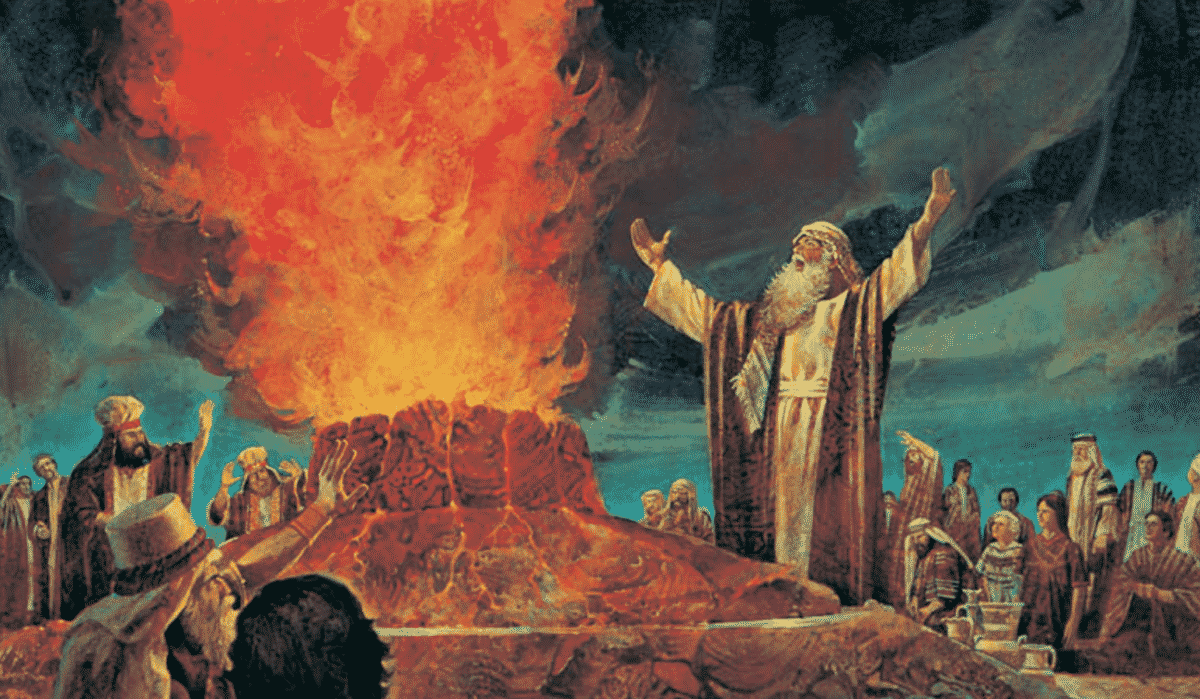
In IKings 18:19-39 the prophets of the false god Baal, and not for a lack of effort or severity, were unable to illicit any response from their otherwise preoccupied god. However, here, not only was the sacrifice unacceptable, but the false god was as well. (Isa. 44:6,8, Isa. 45:21). Immediately after the Baal debacle, God demonstrated his acceptance of Elijah’s offering by a great and dramatic manifestation, this also resulting in a purging of Baal from Israel. Verses 38 and 39 of our referenced scripture segment describe the amazing event: IKings 18:38-39 “Then the fire of the LORD fell, and consumed the burnt sacrifice, and the wood, and the stones, and the dust, and licked up the water that was in the trench. (39) And when all the people saw it, they fell on their faces: and they said, The LORD, he is the God; the LORD, he is the God.”
King Solomon’s sacrificial offering at the dedication of the (Solomon’s) temple received a similar acceptance by God and had the same effect on the people; IICh 7:1-3 “Now when Solomon had made an end of praying, the fire came down from heaven, and consumed the burnt offering and the sacrifices; and the glory of the LORD filled the house. (2) And the priests could not enter into the house of the LORD, because the glory of the LORD had filled the LORD’S house. (3) And when all the children of Israel saw how the fire came down, and the glory of the LORD upon the house, they bowed themselves with their faces to the ground upon the pavement, and worshipped, and praised the LORD, saying, For he is good; for his mercy endureth for ever.”
As mentioned above, the quality of the sacrifice being offered was of utmost importance, however it was not the only consideration, as process also played a key role in gaining and maintaining the Lord’s favor and sacrifice acceptance, as demonstrated by the procedural worship of the tabernacle (i.e., it was not just what you offered, but how you offered it). Along with his promise, providence and protection for Israel through the wilderness, God also demonstrated his presence/acceptance with a pillar of a cloud and of FIRE!
As patterned in the Old Testament, the New Testament covenant features sacrifices and offerings of varying contents and degrees to be offered by its practitioners. For instance, as mentioned, Jesus, the anti-type of the Passover lamb, was, is, and will always be the ultimate and supreme sacrifice to God for the sin of all humanity. However, Hebrews 13:15 reads “By him therefore let us offer the sacrifice of praise to God continually, that is, the fruit of our lips giving thanks to his name.”, an ongoing verbal offering from a heart of gratitude; then the following verse reads “But to do good and to communicate forget not: for with such sacrifices God is well pleased.”. In the practice of our reasonable Christian service, where we see working and giving, God sees sacrifices and offerings unto him.
Though spiritual in nature, New Testament sacrifice and offering, a vehicle of engagement for Christians with their God, retains the same solemn and significant role as it did with Jesus and with Law-abiding Jews. However, the primary sacrificial offering in the New Testament isn’t any verbal expression, nor is it a work, and it is definitely not a beast from the herd, but it is YOU! As Paul indicates above (Rom. 12:1), YOU are the offering!, YOU! are the sacrifice!. Christ-like, you “offer” YOURSELF! to God as a sacrifice!, a HOLY sacrifice. Christ-like, YOU are the offering, and the mode of offering of the New Testament sacrifice is CRUCIFIXION. Jesus indicated as much when he said “…Whosoever will come after me, let him deny himself, and take up his cross, and follow me. Mk 8:34. Paul gives us insight into the spiritual mechanics of how this is accomplished- “I am crucified with Christ: nevertheless I live; yet not I, but Christ liveth in me: and the life which I now live in the flesh I live by the faith of the Son of God, who loved me, and gave himself for me.” Gal. 2:20. Sacrificing oneself to God is “giving”, surrendering oneself to God for his purpose and will to be accomplished in and through your life. However, for it to work, the sacrifice must be ACCEPTABLE, which then brings us directly to this verse, Rom 6:6 “Knowing this, that our old man is crucified with him, that the body of sin might be destroyed, that henceforth we should not serve sin.“
Following the typological pattern, just as there were a variety of physical conditions that would disqualify a sacrificial offering to God in the Old Testament, so there are spiritual conditions (sin) that can disqualify our offering up to him in the New. Willful sin and a sinful lifestyle corrupt the sacrifice of our lives effectively making our offering up to God unacceptable. Again, a sinful lifestyle has the effect of disqualifying one’s sacrifice and “offering up” to God, consequently neutralizing any genuine Christ-oriented spirituality, rendering one powerless and introducing the prospect of threatening one’s eternal standing with God. Also, Paul indicates the necessity of the offering to be “sanctified” (Sanctify: def.- Gr. “hagiazo”: to -make holy, -set apart, -purify, -consecrate. To purify from sin), thus making it acceptable to God. This sanctification then being accomplished, as Paul states above, by the Holy Ghost.
Bible students and honest arbiters of the scripture will know what Paul is referring to when he mentions the “Holy Ghost” in Romans 15:16. Christio-religious gospel detractors will often attempt to isolate a Bible verse in an attempt to manipulate its meaning to subvert the full-gospel of Christ. However, from the beginning of the Gospel story and throughout the book of Acts, which records the first days of the early church and then through the epistles, it is well established that the Holy Ghost is the Spirit of God received and resident in his church body, individually. The Holy Ghost is NOT some bespectacled, briefcase carrying, imaginary 3rd person gadabout racing around with a rubber handstamp to endorse anybody that prays some wholly unscriptural Christio-religious “repeat after me” prayer. Signified by speaking “…with other tongues, as the Spirit gave them utterance”, the Holy Ghost was initially dispensed on the Day of Pentecost (with special exception) as recorded in the Bibles’ book of Acts chapter 2 and recorded multiple times thereafter. And most importantly, it is the Holy Ghost that is the resident, on-board sanctifier of the offering of our life to God. Without the Holy Ghost, a church-attending, Christio-religious offering is unacceptable! (This made Cain angry too.). You may be offering up a sacrifice, that is, adhering to some form and measure of Christio-religiosity, but is it acceptable to God?
Simply put, the Holy Ghost (offering sanctifier) and ongoing willful sin (offering disqualifier) cannot cohabitate in the same vessel. The sin renders the sacrifice unacceptable.
Today’s evil (Gal. 1:4, IITim. 3:1, Phil. 2:15, IJn. 5:19) and ever-corrosive American libertine culture infests a powerless Americanized Christio-religious pseudo-church (IITim. 3:5), but also even attacking and influencing Apostolic circles. Choosing willful sin instead of clear biblical admonition, many have chosen to believe the grievous error that Christ’s cross upon which he died is the only one to be born, thus “liberating” them to a life of sin and self-will. It is a misguided idea to think that since Jesus died for all sin, one can then continue in sin without concern, as all sin was previously extinguished at Calvary. To subscribe to this devilish fallacy requires one to ignore the overwhelming volume of scriptural evidence to the contrary, even as Jesus said “…go, and sin no more.” (Jn. 5:14, 8:11).
If your desire is to serve and please God, to have the sacrifice and offering up of your life to be accepted of him, the following scriptural references are invaluable.
Rom. 6:1-23/ ICor. 6:9-11/ IICor. 7:1, 12:21/ Gal. 5:19-21/ Eph. 4:17-32/ Col. 3:5-9/ IThess. 4:3-8/ ITim. 5:20/ IITim. 2:19, 4:3-4/ Tit. 2:11-12, 3:10-11/ Heb. 3:12-13, 6:4-8, 10:26-31, 10:38-39, 12:14-17/ Jam. 1:14-16, 1:21, 4:4, 4:11/ IPet. 1:13-16, 2:21-23, 4:1-4, 4:15/ IIPet. 2:1-22, 3:10-14/ IJn. 1:6-9, 2:1-11, 2:15:17, 3:1-24, 4:4-6, 5:17-19/ IIIJn. 1:11.
Accepting the sacrifice, “…he shall baptize you with the Holy Ghost, and with FIRE:” (Matt. 3:11, Luke 3:16)
GS
 A Fine Tune
Leave a comment