
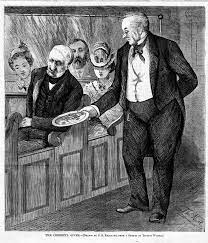
To be a member-in-good-standing in most Apostolic/Pentecostal and other Bible-oriented churches, one must certainly commit to a strict adherence to today’s conveniently modified version (money only) of tithing inspired by the Old Testament Law of Moses, backed up by Malachi 3: 8-10. There are also churches that require something they call “back-tithes”; this neat little abomination “double-down” sounds like something straight out of the horrors of dark-ages Roman-Catholicism. Back-tithes requires any former member (“backslider”) of a church who later returns, to cover his tithe “bill” for the period of time he was out of church! Yes, this is a real thing 😲. I’ve also witnessed others who require “offerings” in addition to tithes, noting that such terminology (“tithes and offerings”) demonstrates among other things, a deference to the Old Testament schematic.
Again, if there is a New Testament version of the O.T.’s Mal. 3: 8-9, it would be IICor. 9: 6-7 “But this I say, He which soweth sparingly shall reap also sparingly; and he which soweth bountifully shall reap also bountifully. (7) Every man according as he purposeth in his heart, so let him give; not grudgingly, or of necessity: for God loveth a cheerful giver.” I’ve observed that this verse is the “Acts 2:38” of NT giving so-to-speak; converting OT inspired tithing traditionalists to its prevailing NT truth is like converting a trinitarian to Jesus’ name baptism, and like Jesus’ name baptism, giving, not tithing, is addressed quite frequently throughout the New Testament scriptures. Bible readers will be familiar with the words of Jesus where he said “Give, and it shall be given unto you; good measure, pressed down, and shaken together, and running over…” Lk. 6:38, and Paul quoting Jesus “…It is more blessed to give than to receive.” Acts 20:35, as well as the many other references to giving throughout the NT. However today, so as to accommodate New Testament scriptures concerning giving, tithing traditionalists maintain that the above (IICor. 9: 6-7), and all New Testament teaching on giving is to be practiced in addition to OT mandated tithing. For them tithing is today’s LAW, but giving is just an optional freelance Christian activity.
Free the Tithe
This may come as a surprise to the reader, but the purpose of this article is not to decry tithing per se, but it is to detach today’s practice of giving, tithing, offering or otherwise, from the spirit, mandate, and intimidation of the Old Testament Law. It is errant to cite the O.T. Law and reference Malachi 3: 8-10 as a threatening cudgel in order to coerce “payment” of the tithe, as well the tither is errant to pay out of “necessity” that is, feel required to give (IICor. 9:7). However, once the proper motivation and liberty of GIVING is established, the tithe (tenth), at the giver’s discretion (“as he purposeth in his heart”), can become a very helpful and Bible-based regulating guide for consistent GIVING.
I vaguely remember bits and pieces of a conversation I had some years ago in which the subject of tithing was being discussed. While explaining the difference between “paying tithes” and “giving” tithes, I remember feeling somewhat stunned and insulted at what I considered an affront to the truth as someone (who should’ve known better) chimed in with somewhat of an exasperated tone saying, “What’s the difference between paying tithes and giving tithes? it’s the same thing”. This said in the same tone and disposition, and perhaps with the same reasoning that “bagman” Judas Iscariot might have said it (Jn. 12: 4-6). If you value truth over money, you know that there is a 99.9% difference between paying tithes (the Law) and giving tithes (Grace), if you value money over truth, then to you there is no difference at all… Judas. Our friend who “should’ve known better” demonstrated a complete disregard to the teaching of the Word regarding motive and instruction on giving, as he demonstrated a disappointing get-it-any-way-you-can-get-it mentality concerning money.
Paying your church out of obligation makes you a customer, giving to your church (of your own free will) makes you a participant; the motivation is everything. The nature of the western business/corporate model of today’s church organizations and local assemblies largely contributes to the local assembly’s need for “paying customers”. With the “want of the saints” being self-mollified by haggard, career-seeking husbands AND wives (contrary to the scripture) striving amongst the thorns (Matt. 13:22), and consequently their church leaders tithed into a middle to upper class stratum, today’s Mal. 3: 8-10 church is a boat that does not want to be rocked, but a rock is coming! 😮
Abraham and Jacob’s tithing
Gen. 14: 18-20 “And Melchizedek king of Salem brought forth bread and wine: and he was the priest of the most high God. (19) And he blessed him, and said, Blessed be Abram of the most high God, possessor of heaven and earth: (20) And blessed be the most high God, which hath delivered thine enemies into thy hand. And he GAVE him tithes of all.”
Gen. 28: 20-22 “And Jacob vowed a vow, saying, If God will be with me, and will keep me in this way that I go, and will give me bread to eat, and raiment to put on, (21) So that I come again to my father’s house in peace; then shall the LORD be my God: (22) And this stone, which I have set for a pillar, shall be God’s house: and of all that thou shalt give me I will surely GIVE the tenth unto thee.”
Having been challenged on their modified (preferably money only) Law of Moses tithing doctrine, traditional tithing proponents have been prodded from their doctrinal neglect and forced to dig deeper into the scriptures to substantiate their New Testament tithe teaching. Unfortunately however, that “digging” does not occur in the New Testament, but in the book of Genesis, 500+ years before the Law of Moses. Though removed from us today by approximately 4 millennia, Abraham and Jacob’s tithe-giving events remain viable as instructive references, bridged to the New Testament church by a common faith (Rom. 4: 11-16, Gal. 3: 7-9).

However, like the timeframe/dispensation of Moses’ Law, Abraham clearly operated under a different set of rules than today’s church. For instance, both Abraham and Moses kept the covenant of literal circumcision, however this is not a NT church requirement (Acts 15: 1-31, Rom. 2: 28-29, Gal. 5: 2-6). Also, Abraham and Moses engaged in physical, militaristic battles slaughtering opposing armies, but we know this is not a church mission for sure (IICor. 10: 3-4, Eph. 6:12). Multiple wives, concubines and handmaids characterized the socio-domestic settings of Jewish antiquity; However, I know of no Mormon-ecostals today, at least not yet, etc. Likewise tithing, codified in the Law of Moses and practiced by Abraham and Jacob (and probably Isaac and many more) is not explicitly defined or even inferred to as a New Testament activity…
But giving is.
A distinction exists between the tithe-giving of Abraham/Jacob and that which is described in the Law of Moses, and it is this, Moses the lawgiver legislated payment of the tithe, but Abraham and Jacob, as the scriptures do testify, voluntarily and willfully GAVE it. It is here in the disposition of an uncompelled act, not Law-induced paying, but-faith-induced giving, that Abraham, the father of the faithful (Rom. 4:16, Gal. 3:7), and Jacob, again resonate with their New Testament descendancy; Jacob even making his continued giving contingent upon God’s continued blessing. The NT church does not walk in the law of Moses, but in the faith of our father Abraham; The law demands payment, faith liberates to give, and the biblical “tenth” principle is there for your guidance, if you so choose. Also, note that the primitive, early-Acts church, apparently not continuing in the Law of the tithe, did not give or pay a tithe, they gave ALL (Acts 2: 44-45, Acts 4: 32-37).
GS
 A Fine Tune
Leave a comment