
The name Jezebel has long lingered in the American lexicon as that ready deprecation for the woman of “easy virtue” who advertises such with her “loose” behavior and immodest appearance, a “floozy”. This appellation is drawn from the biblical character Jezebel, the Sidonian wife of Ahab, a wicked and corrupt king of Israel.
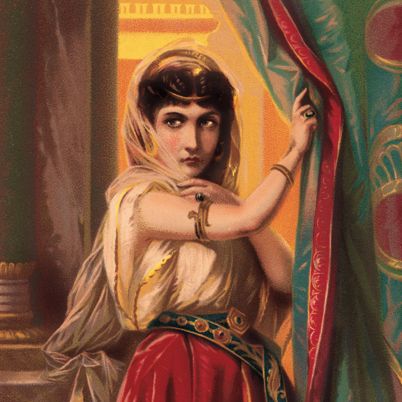
The biblical story from which we draw this current use of Jezebel’s sullied name can be found in the Old Testament book of IIKings chapter 9. As the story relates, the time had come for God’s prophesied judgement (IKings 21:23, IIKings 9:10) to be executed upon Jezebel. In an apparent attempt to dissuade her executor (Jehu), Jezebel “…painted her face, and tired (groomed) her head…”, this implying the use of her feminine wiles in hopes of avoiding death. Whether the now older Jezebel just no longer held the allure or simply God’s time had come, her scheme, if that’s what it was, didn’t work as she was summarily thrown out of a window, trampled under horse hooves and according to the prophecy eaten by dogs.
I’ve not heard the term Jezebel used in recent years to describe this uniquely feminine and wayward, profligate profile. Perhaps this is because in today’s morally deteriorated society “Jezebellian” culture could be considered by many a preferred norm; calling somebody a Jezebel today is somewhat passe’ and perhaps would illicit nothing more than a shoulder shrug.
However, given the scriptural account of her life, relegating the name of Jezebel today to describe simply a morally loose woman and her extravagant use of cosmetics is somewhat of a misnomer in my opinion. Though “painting” her face is mentioned in the scripture thus demonstrating her manner, when compared with the power-exploiting evil that Jezebel demonstrated, the fact that she “…painted her face, and tired (groomed) her head…”, could simply be considered a biographical footnote.
When reading the biblical account, the first thing one notices about Hillary… er, I mean Jezebel is she fully exploits her marriage to her husband (King Ahab) to exercise her own power and will with seemingly little to no restraint or inhibition of conscience. Note these biblical points about Jezebel: Not a Jew, Jezebel was a foreign import, she was the daughter of Ethbaal, king of the Zidonians, where Ahab, the wicked king of Israel “went and served Baal and worshipped him”. The scriptures also yield this report concerning Israel’s king Ahab, Jezebels husband, “…he reared up an altar for Baal in the house of Baal, which he had built in Samaria. And Ahab made a grove; and Ahab did more to provoke the LORD God of Israel to anger than all the kings of Israel that were before him.” That is, along with Jezebel, wicked, backslidden Ahab also imported her idolatrous religion. Also, along with the altar of Baal, Ahab made a “grove” which according to history facilitated the worship of Asherah, a Canaanite fertility goddess (I can guess whose idea that was).
Hilla… er, Jezebel’s way of dealing with inconvenient people was to simply murder them, and first on the list were the prophets of the LORD (IKgs. 18: 4/13), as her false gods of Baal and Asherah had their own “prophets”, the LORD and his prophets were no longer welcome in Samaria. Next on her kill list was the prophet Elijah (IKgs. 19:2), but God had other plans for him which didn’t involve death at the hands of Ahab’s whorish witch Jezebel (IIKgs. 9:22). Next, a Jezreelite named Naboth refused to sell his inherited property to Jezebel’s husband Ahab, causing him no little consternation. But Jezebel knew exactly what to do – murder the guy, which she did at the hands of the city’s elders and nobles (IKgs. 21: 1-16).
Upon the pronouncement of God’s judgement to come upon king Ahab, the scriptures reveal his consideration of, and reverence to God as “…he rent his clothes, and put sackcloth upon his flesh, and fasted, and lay in sackcloth, and went softly” IKgs. 21-27. This approach with his self-centered concerns is the only record of Ahab demonstrating any regard to Jehovah God in the scriptures as IKgs. 21:25 records his true legacy – “But there was none like unto Ahab, which did sell himself to work wickedness in the sight of the LORD…” adding, “…whom Jezebel his wife stirred up“. No other king of Israel’s summary makes such a reference to his wife. When studying the Ahab/Jezebel saga, one is left with the sense that Hil… er, Jezebel, the privileged Sidonian that she was, acted without reservation, manipulated her husband Bil… er, Ahab, and enjoying the power afforded to her by her marriage to the king, flourished in their evil enterprise.
The scriptures even cite Jezebel’s corrupt influence on her (and Ahab’s) son and heir to the throne, king Ahaziah saying “…he did evil in the sight of the LORD, and walked in the way of his father, and in the way of his mother… (53) For he served Baal, and worshipped him, and provoked to anger the LORD God of Israel, according to all that his father had done.” (IKgs. 22: 52-53). After suffering an apparently serious accident (IIKgs. 1:2) Ahaziah passed away (IIKgs. 1: 16-17), his brother Jehoram then assuming the throne. The Bible then specifies that Jehoram “put away the image of Baal” yet, “…he wrought evil in the sight of the LORD; but not like his father, and like his mother“. Yes, Jezebel certainly made a name for herself, an evil one.
In the Bible the name Jezebel disappears with her violent demise recorded in IIKings 9: 30-37, but then makes a curious resurgence all the way back in the book of Revelation chapter 2. Here, among the 7 churches of Asia the apostle John addresses the church of Thyatira (Rev. 2: 18-29), stating that certain sins and violations against God were being, not just committed, but taught in the form of a doctrine (teaching) there, namely fornication and idol worship; the perpetrator of this spiritual subversion is none other than someone or something (spirit of) named Jezebel. Whether this Jezebel is a reference to a person, an ideology, or a spirit, the identifying name of said “seducer” is revelatory and tells us everything we need to know about the situation there.
First, Thyatira’s Jezebel is identified as “that woman”, a female. Second, like Ahab, the church of Thyatira allowed Jezebel to work her wickedness unrestricted, as the scripture reads, “Notwithstanding I have a few things against thee, because thou sufferest that woman Jezebel…” Thirdly, this Jezebel was self-called and asserted herself into ministry “…which calleth herself a prophetess…”, and accordingly taught and demonstrated corruption, “…to teach and to seduce my servants to commit fornication, and to eat things sacrificed unto idols.” Rev. 2:20. Apparently endorsed and perhaps even encouraged by her church surroundings, Revelation’s Jezebel mostly resembles her eponymous predecessor with her self-willed, unrestrained influence and assumed authority, teaching and encouraging a false doctrine of sin. Though her feminine qualities, i.e. painting her face/salacious grooming, are a prominent part of the whole Jezebellian package, it is the lust for control, power, manipulation and influence that Jezebel, the libertine witch of Thyatira desires.
The apostle Paul wrote the following to his younger protege Timothy; “Let the woman learn in silence with all subjection. (12) But I suffer not a woman to teach, nor to usurp authority over the man, but to be in silence” (ITim. 2: 11-12). And then he gives his reason (13) “For Adam was first formed, then Eve. (14) And Adam was not deceived, but the woman being deceived was in the transgression” (ITim. 2: 13-14). Is Paul here impugning the whole female gender for all time because of the error of Eve in the garden OR is he simply pointing out an inherent spiritual “vulnerability” unique to Eve and subsequently to all woman, a vulnerability (susceptibility, naïveté) that is remedied by subjection to their covering (man)? I believe it is the latter.
The apostle Peter said “Likewise, ye husbands, dwell with them according to knowledge, giving honour unto the wife, as unto the weaker vessel…” (IPet. 3:7). This means that the husband should recognize and acknowledge that the wife, as a woman, is generally weaker… in every way – physically, emotionally, mentally, and spiritually. This is how God created us (regardless of what the rot and perversions of a Sodom and Gomorrah culture would otherwise tell you). This weakness as demonstrated by Eve, and overtly manifest in creation, can be uniquely susceptible to demonic deception and manipulation. So much so that Paul cited Eve’s disqualifying transgression when alerting Timothy and then relaying a similar admonition to the church in Corinth (ICor. 14: 34-35). The church or ministry that ignores Paul’s warnings and accommodates the ambitious woman’s ministry/ministerial aspirations to leadership, like Ahab and Thyatira, co-conspires with the spiritual vulnerability embedded in the feminine giving rise to a potential Jezebel – idolatry (covetousness, worldliness) and fornication (sexual promiscuity) may soon follow, if for no other reason, her weakness.
“And unto the angel of the church in Thyatira write; These things saith the Son of God, who hath his eyes like unto a flame of fire, and his feet are like fine brass; (19) I know thy works, and charity, and service, and faith, and thy patience, and thy works; and the last to be more than the first. (20) Notwithstanding I have a few things against thee, because thou sufferest that woman Jezebel, which calleth herself a prophetess, to teach and to seduce my servants to commit fornication, and to eat things sacrificed unto idols. (21) And I gave her space to repent of her fornication; and she repented not. (22) Behold, I will cast her into a bed, and them that commit adultery with her into great tribulation, except they repent of their deeds. (23) And I will kill her children with death; and all the churches shall know that I am he which searcheth the reins and hearts: and I will give unto every one of you according to your works. (24) But unto you I say, and unto the rest in Thyatira, as many as have not this doctrine, and which have not known the depths of Satan, as they speak; I will put upon you none other burden. (25) But that which ye have already hold fast till I come. (26) And he that overcometh, and keepeth my works unto the end, to him will I give power over the nations: (27) And he shall rule them with a rod of iron; as the vessels of a potter shall they be broken to shivers: even as I received of my Father. (28) And I will give him the morning star. (29) He that hath an ear, let him hear what the Spirit saith unto the churches. Rev. 2: 18-29
GS
 A Fine Tune
Leave a comment