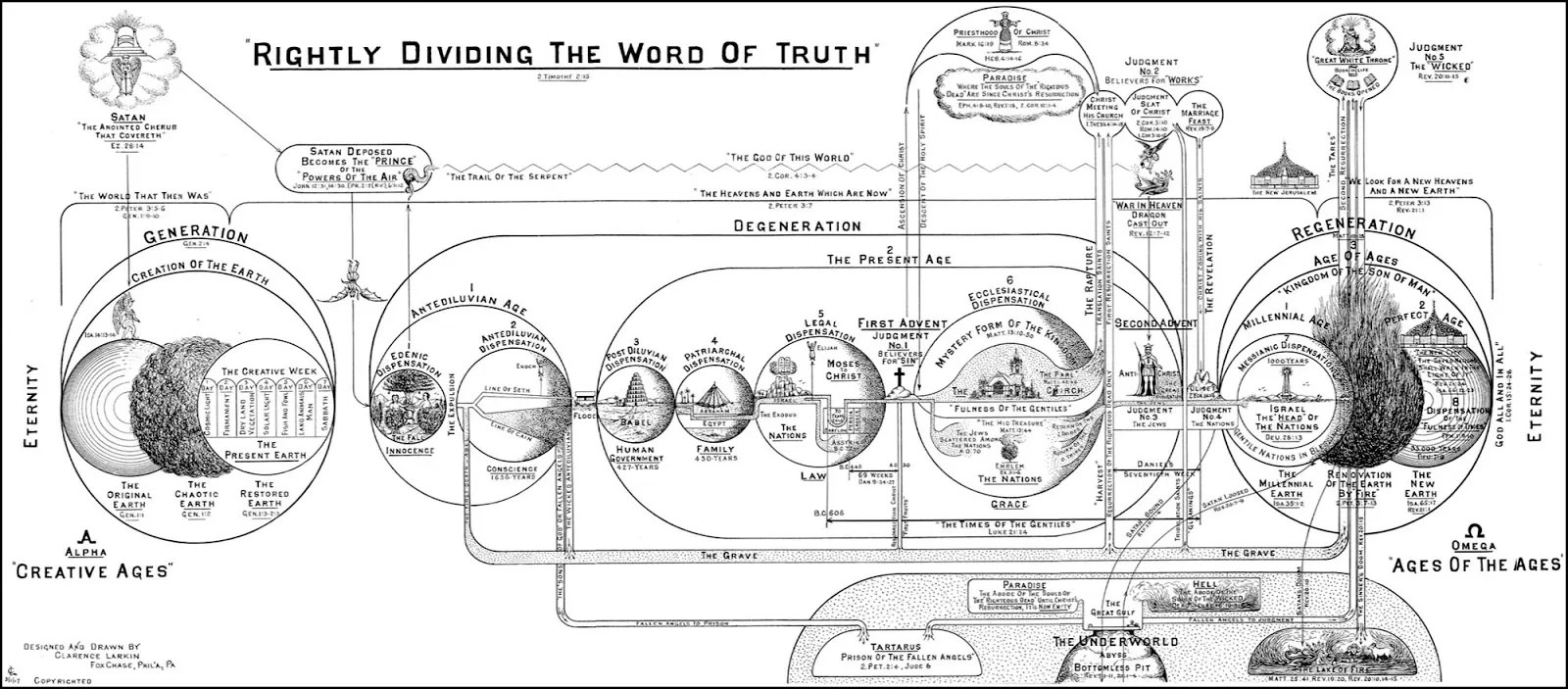
Dispensationalism is that useful framework whereby the panorama of the whole Bible Story is chronologically divided into historical periods called “dispensations”. Each dispensation is differentiated by the unique and prevalent way that God “dispensed” Himself and His truth to the world within that particular time frame, with each also featuring certain parameters wherein human compliance was required.
There is some debate about the actual number of dispensations, but the most common teaching on this subject features the following seven: 1. Innocence (From creation to the fall), 2. Conscience (From the fall to the flood), 3. Human Government (from Noah to the tower of Babel), 4. Promise (From Abraham to Moses), 5. Law (From Moses to the death of Christ), 6. Grace (From Pentecost to the rapture), 7. Kingdom (The Millennial Reign of Christ). These then representing a chronological unfolding of the overall plan of God from beginning to end, it is alleged.
However, a closer look may reveal a few glitches in the schematic. For example, dispensation #4 suggests that God’s promise to Abraham prevailed until the Law of Moses, but we know that the promise of Abraham endured long past Moses era and was realized in the birth of Jesus, this rendering Moses’ Law to have been but a “sub-dispensation” (of Promise) of sorts (Gal. 3: 16-19). Also, it is true that #5- the Law of Moses ended with the death of Christ on the cross (Col. 2:14, Eph. 2:15), however, and more to the point of this article, #6-Grace “snuck in” and began to show itself in Christ’s ministry (Jn. 1:17) before Pentecost- the beginning of the church age, with the two periods (Old/New Testaments) overlapping together in Christ more like a handshake rather than abutting like a property line. [It is human nature to squeeze things into nice, neat, organized, easy-to-understand boxes, and what, with the “perfect” number seven (dispensations) and all, but any man-made construct projected onto the Word of God is bound to run into complications.]
During his earthly traverse, Jesus did not disregard the Law (Matt. 5: 17-19), but transcending and fulfilling it he simultaneously introduced “a new and living way” (Matt. 5: 21-48, Heb. 10:20), revealing “…the glory that excelleth” (IICor. 3;10). In John chapter 8: 3-11, Jesus forgave an adulteress contrary to the Law (Lev. 20:10, Deut. 22:22) as “mercy’s face pressed against the veil” so-to-speak (props to PCD). Also, accused by Pharisees of violating the law of the Sabbath day, Jesus pulled rank stating “…the Son of man is Lord also of the sabbath” (Lk. 6:5). Also, instead of it rendering him to be unclean as he touched and healed lepers, Jairus’ dead daughter, and himself being touched by “…a woman having an issue of blood”, Jesus wielded a power (mercy) greater than the judgment of the Law , reversing the direction of its effectual flow like a mighty earthquake does a river.
“Who can forgive sins, but God alone?” Lk. 5:21, was the response of the Scribes and Pharisees as Jesus, revealing who he was, forgave a paralytic of his sins, as the Law’s sacrifices, Levites, and temple processes were nowhere to be found. However, after Jesus performed their healing, full legal and social restoration for a “cleansed” leper (Lev. ch. 14) would require the function and certification of a Levitical priest (Matt. 8: 2-4, Lk. 17: 12-14).
These events and teachings along with others indicate that “Beginning from the baptism of John, unto that same day that he was taken up…” (Acts 1:22) represents its own dispensation and what I’ve come to call the “Dispensation of Christ”.
[And as an aside, John the Baptist’s short ministerial period, by definition could also be considered its own dispensation (or perhaps sub-dispensation) as it appears obedience and submission to God and the remedy for sins would then be achieved through John’s baptism (Mk. 1: 4-5, Lk. 3:3) not Moses’ Law (Lev. 16:29-30) as had been the case, as the Law-fulfilling power of Christ (Matt. 5:17) began to emerge. Serving as an endorsement of the authority of John’s baptism, Jesus subjected himself to the same (Matt. 3: 13-15). As we can see, the dispensational structure can get murky; perhaps this is why it is not often discussed or referred to.]
The 4 Gospel’s are the records of what I consider to be the “Dispensation of Christ” with the introduction of grace at the beginning of Jesus’ ministry and the termination of the Law at the end, these being merged by the miracle of Christ. Jesus’ ministry, in words and deeds, reflects both and at once a commingling and a dissolution of the Law/Grace transition as he, the glory that excelleth, trumped the Law of Moses (ultimately fulfilling it) while demonstrating Grace (ultimately dispensing it).
From a dispensational standpoint, to view the Law as simply transitioning into grace- the church age, thus relegating the pre-resurrection Jesus to the dispensational obscurity of being only subject to the Law without (dispensationally) recognizing the preeminent and transformational nature of his earthly presence and ministry, reflects a lack of consideration as to just who Jesus is and what He represents. The 3 1/2 year “Dispensation of Christ”, as I have termed it, is not just its own dispensation, but it is the apex of all dispensations, as even the victorious Millennial kingdom builds on the “revolutionary” success of the Dispensation of Christ.
Indeed, unique to the Dispensation of Christ was the participating role and sacrificial performance of “…the Lamb of God, which taketh away the sin of the world.” (Jn. 1:29), the dispenser himself, as “…the Word was made flesh and dwelt among us” and “…in him dwelleth all of the fulness of the Godhead bodily”, “…as a son over his own house”. with his name being thusly called “…the mighty God”, “Emmanuel”, even Jesus -Jehovah has become salvation -The Christ, The anointed One.


Leave a comment